Why this pattern is common
Holiday travel lines up with some of the coldest weeks of the year on the Front Range, and it is natural to lower the thermostat before leaving an empty house. The trouble is that pipes in exterior walls get their warmth from the room air, and a few degrees lower inside can be the margin that matters on a subzero night with wind.
This situation is assembled from common patterns. It does not describe any real household, home or claim.
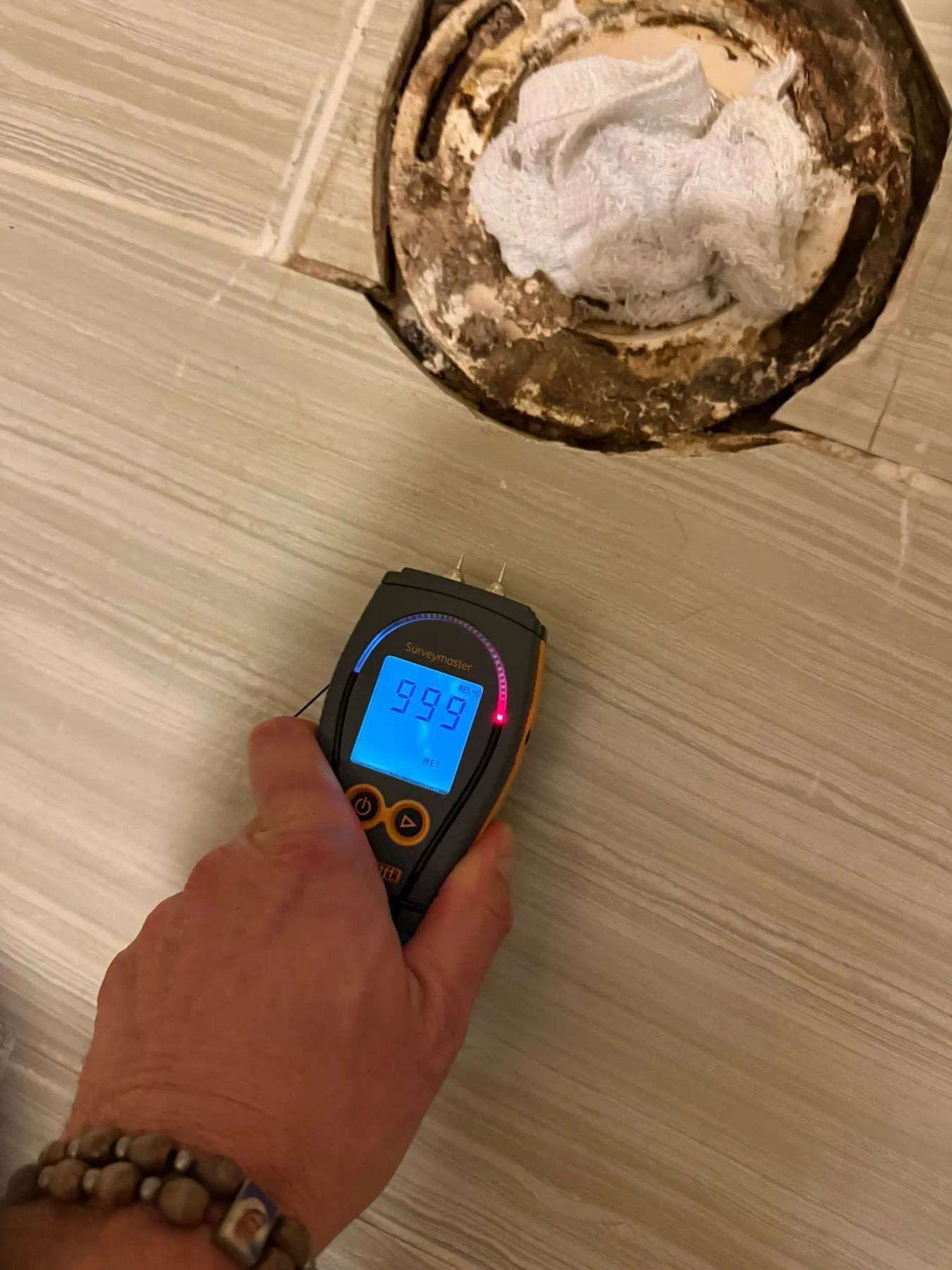
Moisture meter on tile beside a toilet flange with the toilet removed. Included to show the kind of work involved, not a property or job connected to this site.
The situation
Illustrative example. Not a real job or customer.
A hypothetical two-story home in a Parker subdivision built in the early 2000s. The primary bathroom sits on the north side, with the double vanity against an exterior wall. Before leaving for nine days, the household sets the thermostat to 50°F and asks a neighbor to check the house every few days.
- On the second night away an arctic front drops temperatures well below zero with a strong north wind.
- The cold supply to one vanity sink, running inside the north wall, freezes and splits at a fitting about a foot below the valve.
- The ice holds for a day. When the sun warms the wall the following afternoon, the plug melts and water begins running inside the wall cavity.
- Water travels down to the floor framing and spreads into the ceiling of the family room below.
- The neighbor arrives two days later, sees a sagging, stained ceiling, and smells damp. Having been shown the main, the neighbor closes it and calls the owners.
- The owners call their insurer and a plumber from the road, and ask the neighbor to photograph each room before anything is moved.
The plumber repairs the fitting and notes the freeze. A drying contractor removes the family room ceiling drywall and wet insulation, opens the lower vanity wall, and dries the framing over several days. The insurer asks about the thermostat setting and the check schedule; the household provides the photo of the thermostat taken before leaving and the neighbor's texts.
What helped and what hurt
| Helped | Hurt |
|---|---|
| The neighbor knew where the main was and closed it immediately | A thermostat setting lower than many insurers and plumbers suggest |
| Photos of every room before cleanup started | Checks every few days during a forecast arctic front |
| A dated photo of the thermostat setting before departure | Water left on in an empty house for over a week |
| The plumber wrote down where and why the pipe failed | Vanity cabinet doors closed, trapping cold against the wall |
If you are planning a similar trip
- Keep the heat at around 55°F or higher, and higher still if a cold snap is forecast.
- Close the main before leaving, and open a faucet briefly to drop pressure.
- Leave cabinet doors open on exterior-wall sinks.
- Ask your checker to visit daily during any forecast below about zero.
- Install a temperature alert or smart thermostat that warns you if the house cools.
General information for Parker, not a quote or professional advice. In an emergency, call 911.